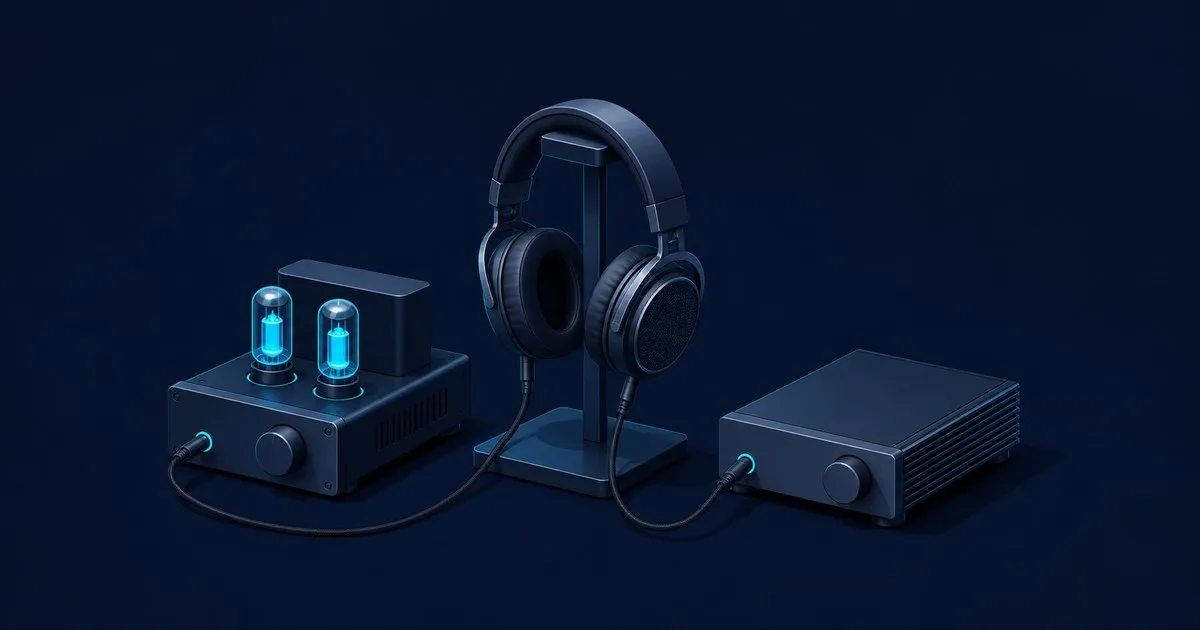
Tube vs Solid State Headphone Amp: Which Fits?
Tube or transistor is not the key spec. Compare output impedance, load-tested power, gain, noise, distortion, and ownership costs before buying.
A tube vs solid state headphone amp decision is less about a universal “warm versus clinical” contest than about electrical fit. A conventional solid-state amp is usually the safer default for low-impedance planars, sensitive IEMs, and listeners seeking neutrality. An output-transformerless (OTL) tube amp can be an excellent intentional pairing for high-impedance dynamic headphones, provided you want its particular response and distortion rather than treating tubes as an automatic upgrade.
Affiliate disclosure: This article contains no affiliate links. Manufacturers are linked only as primary sources for published specifications.
Who this comparison is for
This is for someone choosing a desktop amplifier for daily work, long listening sessions, or audio production. If you own several headphones, dislike hiss, or want the recording reproduced with minimal alteration, start with solid state. If you have one known high-impedance dynamic headphone and enjoy experimenting with tubes, an OTL design may make sense. A hybrid tube amp sits between those cases: a tube handles voltage gain or coloration while transistors provide current to the headphone.
Do not choose by headphone impedance alone. Sensitivity tells you how much sound a headphone produces for a stated voltage or power; impedance tells the amplifier what electrical load it must drive. A low-impedance, low-sensitivity planar may demand substantial current. A high-impedance dynamic model usually asks for more voltage. The amp’s power specification must therefore be given at, or near, your headphone’s load.
Specs that matter more than the badge
| Specification | What it changes | What to check |
|---|---|---|
| Output impedance | Frequency-response interaction and electrical damping | The published value in each gain mode |
| Power versus load | Clean volume and headroom | Power or voltage at your headphone’s impedance, with a stated distortion limit |
| Gain | Volume-control range and noise | A low-gain setting for sensitive headphones; enough high-gain voltage for demanding ones |
| Noise | Audible hiss, especially with IEMs | Load-tested noise or signal-to-noise data, not “black background” copy |
| THD+N and IMD | Added harmonics, intermodulation, and noise | Measurements under a realistic headphone load and at normal output |
| Protection | Risk to headphones | DC, over-current, delayed-start, and shutdown muting |
Output impedance deserves the most attention. Headphone impedance changes with frequency, so a high source impedance forms a frequency-dependent voltage divider with the headphone. The result can be a tonal shift rather than some vague increase in “musicality.” Benchmark’s measurements explain why a near-zero-ohm source gives more predictable frequency response and damping. That is the neutral engineering target, not a guarantee that every listener will prefer it.
OTL, hybrid, and solid state in real specifications
“Tube amp” covers circuits that behave very differently. These three published examples make the point:
| Example | Topology | Published output impedance | Published output capability | Sensible pairing |
|---|---|---|---|---|
| Bottlehead Crack 1.1 | Single-ended OTL tube kit | 120 Ω | About 10 V into 300 Ω | High-impedance dynamic headphones |
| Schiit Vali 3 | Tube-voltage stage, bipolar output stage | 0.5 Ω low gain; 1.8 Ω high gain | 1.5 W into 32 Ω; 0.4 W into 300 Ω | Broad compatibility, subject to noise and gain needs |
| JDS Labs Atom Amp 2 | Solid state | 0.7 Ω | 2.65 W into 32 Ω; 143 mW into 600 Ω | IEMs through demanding low-impedance headphones |
The numbers are not directly interchangeable. Schiit states that its maximum-power figures for tube and hybrid products use a distortion ceiling below ten percent, while its solid-state criterion is below one percent. JDS labels its figures “maximum continuous power.” This is why a large wattage in a product card is not enough; test condition, load, and distortion threshold matter.
The Crack illustrates the classic OTL tradeoff. Its high output impedance and strong voltage capability are deliberate, and Bottlehead explicitly positions it for high-impedance headphones. It is a poor universal recommendation. The Vali 3 shows why “tubes cannot drive planars” is also too broad: its solid-state output stage produces much lower output impedance than an OTL circuit.
What the audible difference can be
A tube does not automatically produce warmth, and a transistor does not automatically sound sterile. Circuit topology, feedback, transformers, operating point, gain, and load all matter. IEEE Spectrum’s engineering history of tube audio notes both the low-order distortion associated with some tube and transformer circuits and the fact that modern tube gear can be designed without the stereotypical soft character.
When two amps operate within their clean limits and have flat response, low noise, and low output impedance, expect the difference to be small. When a tube amp is obviously different, the likely mechanisms are measurable: response change from source impedance, harmonic distortion, noise, or overload behavior. None is automatically bad if it is the effect you intend to buy.
Do not rank products from one THD number. The Audio Engineering Society paper Perception of Nonlinear Distortion explains that audibility depends on the type of nonlinearity, signal level and content, the rest of the chain, listening conditions, and the listener. A distortion spectrum and measurements across level and load are more useful than a lone best-case figure.
Which amp should you buy?
Choose solid state if you want one amp for a mixed headphone collection, use sensitive IEMs, own low-impedance planars, or make mix and mastering decisions. Look for low output impedance, low gain, low noise, and adequate current at the relevant load. For speech analysis or forensic work, neutrality is also the defensible choice; amplifier coloration cannot authenticate a recording, and voice-deepfake verification is a separate security problem.
Choose an OTL tube amp if the manufacturer explicitly supports your high-impedance headphone, you want audible interaction rather than strict neutrality, and tube replacement is part of the appeal. Choose a hybrid or transformer-coupled tube amp when you want some tube-stage behavior but need lower output impedance or more current. Verify the actual output specification; the glass on top tells you almost nothing about the output stage.
Before keeping either, compare through the same DAC and headphones, match electrical output levels, and listen for hiss during quiet passages, bass changes, constrained peaks, channel imbalance near the bottom of the volume range, and mechanical hum. Start with the volume down. More available power is headroom, not permission to listen louder: NIOSH treats 85 dBA averaged over an eight-hour workday as hazardous occupational exposure, while noting that individual susceptibility varies.
Tube ownership also means heat, fragile glass, possible microphonics, and a consumable part. Warranty language is revealing: Schiit covers the Vali 3 for two years but its supplied tube for ninety days. Pay extra for that ownership experience only if you want it. For most buyers, a competent solid-state amp is the technically safer and more versatile answer; tubes are an optional flavor, not the next rung on a quality ladder.
Sources
Related

Balanced vs Single-Ended Headphone Amp: Specs Compared
The spec-based guide compares balanced and single-ended headphone amp outputs by power, noise, impedance, connectors, and when extra headroom matters.

What Is a DAC in Audio? How It Works and What Matters
A DAC converts digital audio samples into analog voltage. This guide covers sigma-delta conversion, key specs, jitter, and when an external DAC can help.

Combo DAC/Amp vs Separates: Which to Buy
One box or two? A specification-led comparison of combined DAC/amp units against separate stacks, covering noise, cost, features and upgrade paths.